E-verything!

E-verything – I am interested in all things “e” that might have a link to learning & I think that means everything! Also sometimes digress into food, gardening and managing the wonderful place where we live.

Twitter – what makes me follow someone?

Just recently I have been thinking about how many people I follow and how I manage them. This was triggered by reaching the stage where Tweetdeck doesn’t load all my overnight tweets when I log on in the mornings so I have to look elsewhere. I have been in Twitter for about 6 months and have let my stream grow slowly (at this moment I follow 138 and am followed by 172). I like to be able to skim all tweets (from when I am offline) otherwise I risk missing interesting/useful/social “nuggets”. As my stream gets much bigger that becomes increasingly hard – particularly as a large proportion of my stream are on the other side of the world or the other side of the country (I am in Westen Australia). So I have just reached the point where there is about an hour of tweets that don’t fit in when I start Tweetdeck in the mornings – going to Web to pick them up is irritating as I then have to do about 10 “mores” to get back that far. However I have now tried using Twhirl for this and so far this is OK to catch those missing Tweets. One of the “nuggets” from my Twitter stream that made me think even more was Brad Stokes’ post ” You don’t need more Twitter followers” I found that I tweeted for very much the 6 reasons given.

I have no desire to develop mammoth follower or following lists. I gain a huge amount from Twitter but already am only able to interact professionally &/or socially (rather than just check the tweets) on a regular basis with about 25% of my stream. For me Twitter is very much a “Personal” professional network and I very much enjoy the opportunities for interaction on the social as well as the professional level. In my opinion following a huge list of people would be counter-productive to getting what I want from Twitter.

Almost all of those that I follow also follow me. I am quite “choosy” about following back when people follow me. I mainly follow educators but also some others with whom I have shared interests (often growing, cooking and eating food) or who just seem interesting when I check out their stream. Mostly I find new people to follow through @replies to existing members of my stream, following some of those who follow me, and through interactions at online forums etc. However I always look at the profile, avatar and Tweet stream before deciding whether to follow. I rarely choose to follow people with protected updates unless I have had contact with them through another context. Similarly I am also less willing to follow those who have no profile information and/or only a stock image for their avatar. Other negatives include: those who follow thousands and have few followers especially if they only have a minimal number of updates; those whose profile or Tweets tell me how to get something for free or how I can get a million Twitter followers;

I try to check out new followers as soon as possible after the email tellling me they are following but this doesn’t always happen. I am ruthless about those following me – corporates, marketers and self-styled social media gurus are almost always blocked. I don’t like being used as a conduit into members of my stream. I also block minors where I can pick them out. This is a personal preference – I am an adult educator who also works with many adolescents who have dropped out of school and I just feel that it is not appropriate for me to have this age group in my professional and social network. If I am unsure about a follower they get benefit of doubt and I don’t block, but my key strategy is to follow only those that have interests in common with me although of course there are occasional exceptions. I also block and report by DM to @spam any new followers that appear to me to be spam, scams, phishing etc.

Elluminate – missing tools?

An occasional issue that I have found arising with Elluminate is when one of the tools or modules doesn’t work properly. If this happens you may find that emptying the Java cache solves the problem. This is also a potential solution to any situation where Elluminate seems to be “behaving” oddly. I have found it to be a good initial troubleshooting activity when students encounter any problems as it is quick and easy to accomplish.

To empty the Java cache (from a windows operating system), close Elluminate if you are currently in a session.
i) Go to Control Panel (switch to classic view)
ii) Find Java and open the Java control Panel
iii) Select the General Tab
iv) Ensure that the space for temporary file storage is set to 1000 MB
v) In “Temporary Internet Files” select Settings
vi) In “Temporary Files Settings” click on Delete Files
vii) Ensure that:
Applications and Applets
Trace and Log Files
are both ticked
viii) Click OK

ix) Close down and then restart the computer – it may take some time to reload all the Java files when you restart and re-enter Elluminate.

Installing Java to use Elluminate – Dialup

If you (or any of your students/participants) have a dialup connection then installing the Java so that you are able to use Elluminate can be a slow process – taking 1-2 hours or even more if you are unlucky.

On a slow connection for the installation one of the issues that can occur is a brief temporary loss of the internet connection. If this happens and you have chosen the online installation option then you may find that the Java download and installation fails. When this happens and the Java Web Start Installer hits an error when attempting to install, it stops the installation and shows an error message. This message will give an indication of why the download has stalled. The most common messages include:

  • Insufficient permissions to install software
  • Insufficient disk space to install software
  • The computer does not meet the minimum system requirements
  • The computer is not currently connected to the Internet

Elluminate recommends that you always use the offline installer. When you reach the Sun website to download your Java for Elluminate make sure that you select the offline installation option and follow the instructions carefully. You can access the latest version of Java here. Remember be sure to select the offline option.

Choosing the offline installation enables the Java download to restart from the point it had reached when the connection was interrupted. Once the download is complete you then install from the local version on your computer. With the online installation the process simply stalls at whatever point it has reached and has to be re-started. If you are on dialup and have a slightly “noisy” telephone line you may never succeed in a complete install if you use the online option.

Good luck with Elluminate!

Imagine your Image – Thoughts about Online PD (24th April)

One of my “go buttons” likely to generate a “rant” is having to wait for ever for images to open/download in websites and e-mail. This is partly because I live and work in an area that has bandwidth issues as a result of its regional location. I also work with regional and remote students some of whom are on dial up connections – this has made me even more mindful of the issues facing people with slow connections or older (slower) computers. This combined with the fact that I love to play with images and encourage students to do so gave rise to an idea for one of the Edublogs/ Elluminate Community Partnership Free Online PD sessions. An overview of the session can be found at the Edublogs Live Events Archive where  you will also find other links that might be of interest and also the link to the recording of the session.

The session was about making your images fit for purpose and I presented it jointly with Phil Hart. We both use free downloadable image editors for a lot of our image manipulation. Main reasons for this include:

  • we can carry them around on a memory stick and install them on anything without licensing issues;
  • we can recommend them to students who can then use them without incurring cost;
  • we can install them on college computers for student use without any issues;

I mainly use PhotoFiltre this is because I find it easy to use, and have also found that students (even those who are not highly “computerate”) also find it quite easy.

This session was fun! I enjoyed making sure that the introductory part was interactive because the opportunity to make online sessions interactive is one of my favourite things about Elluminate. So I included polling, drag and drop and whiteboard activities in the intital discusssion about the need for editing images particularly with respect to size. Then we moved on to more interaction using Application Share to show some of the editing features of Photofiltre and giving participants an opportunity to take control of my desktop and try out some edits for themselves. After that it was Phil Hart’s turn to take centre stage and show some ot the features of GIMP – a rather more advanced (but still free) editing application that allows the use of layers – while I took a rest (ha! ha!) and fielded the text chat. We wound up with some feedback on the session and opportunites for any questions not already dealt with in the text chat.

The text chat is another of the features that makes Elluminate a great tool – especially if two people are co-presenting because the one not actively presenting can watch and respond to this backchannel. Watch this space if you are interested in Elluminate (or virtual classrooms in general) as I often post about some of the activities and Elluminate tools I use to keep  sessions interactive for my students.

Elluminating ideas for interactivity on the whiteboard! WordSearch

I use WordSearches (WordSleuths) in Elluminate (and also in a face-to-face context) in a whole variety of integrated activities. They are particularly useful to me as a literacy lecturer but can also be really useful in any subject that uses specialised vocabulary.

Until recently I created my WordSearches the hard way – using a table filled with random letters and just replacing the letters with the words I wanted each time. However a couple of months ago I found this great online WordSearch maker.

Occasionally I use a WordSearch in its most simple form – just a word square with a list of words to find and highlight using the higlighter tool. Used this way it is a good warm-up or whiteboard tools familiarisation activity. In conjunction with “Explore Objects” on the “Whiteboard” menu under “Tools” I find it useful to get an idea of student participation levels.

Usually when I use a WordSearch either face-to-face or in Elluminate I extend it by asking students to find the meanings of words and then to put those meanings into their own words. In Elluminate this involves asking each student or pair/group to look up one of the words online and to feedback to the rest of the group. There are several different options I use for feeding back: a) audio using the microphone; b) use breakout rooms, type on the whiteboard and then I put the whiteboards into the main room for sharing with the rest of the group; c) use the text chat area; d) create a Wordle of the word and its meaning in their own words and put the link on the whiteboard – we can then Webtour the Wordles or students can visit them individually. A good variation on the last is to create the Wordles without the word itself and then have the other students use Polling to guess which word is being defined in each Wordle.

Setting up a basic WordSearch in Elluminate is very straightforward, especially if you use a WordSearch maker for the hard bit ie making the puzzle.

I usually try to be economical in my resource development and create resources that I can easily convert to alternative formats. As a result my WordSearches are usually pasted into worksheets using my own standard Word worksheet template. This is so that I can use the WordSearches in face-to-face classes as well as easily insert them into Powerpoint (ppt) for uploading into Elluminate. If the WordSearch was created as a table then its just a case of copy and paste the table into ppt, otherwise use Text to Table conversion from the Tables menu in Word. I still use Word for printables because of ease of formatting over html. This is one for use in a literacy context (I am generating a whole set of these using a vocabulary list) – it makes a good whiteboard activity for the start of a class when peolpe are arriving and setting up audio etc.

This is how I put the activity into Elluminate.

1) Putting this activity into Elluminate is easier than putting in Drag and Drop because it is all “background” ie there is nothing that the students need to move.

2) I usually set up these activities as individual ppts because this makes it easier to just insert the activity into any presentation or Elluminate session without having to edit out other material.

3) Copy and paste the WordSearch into your ppt and add the wordlist (usually also copy and paste as saves having to align the words)

4) Duplicate the ppt slide (Insert duplicate slide)

5) At this stage you have a choice you can either complete the second slide with lines/highlighting through the answers or you can wait until you have uploaded and add the answers on the whiteboard. If you take the second option remember that you need to save the two slides in wbd format for using later.

5) Save and close ppt

6) You can then upload the ppt into Elluminate as and when required. Alternatively, if you haven’t completed your answer slide, upload into Elluminate, use the highlighter to highlight answers and save as a wbd

7) It is easy to insert pre-prepared whiteboards or short ppts at any point in an uploaded presentation – just create a new whiteboard (tool next to the upload presentation one) and then replace it with your pre-prepared material.

You are ready to go – have fun!

Elluminating ideas for interactivity on the whiteboard! Drag and Drop!

With students new to Elluminate I always go for a softly softly approach and try not to introduce too many new tools or strategies at once. This also sometimes applies to colleagues especially the e-phobic! If I’m working with e-philic colleagues we can have a great time looking at a whole range of different ways to use tools and keep students interacting. However I’m trying to avoid blog posts that exceed War and Peace in length! So I’ve decided to break all this whiteboard “stuff” down into smaller chunks.

I hope that Kipper and Flipper will help me make these posts memorable!

One of my favourite, and very simple activities on the whiteboard is using Drag and Drop. Here is one that I use in taster or orientation sessions for students.

OK so how do I set them up? There are many different options – these are my personal preferences and what works well for me!

Firstly I usually use PowerPoint (ppt) for my slides in virtual classes/presentations/workshops. There are a number of reasons for this:

a) have been using ppt for years so I’m very familiar with it and find it easy to use;
b) very easy to upload into Elluminate as a complete presentation rather than slide by slide;
c) have a portable, easily edited “down here” version ie not “locked in” to the need to able to open the Elluminate whiteboard file format.

1) I pre-prepare, starting with anything I want in the background in PowerPoint – for drag and drop this is the text or images that I want to be fixed (ie not “draggable” by the learners).

2) Duplicate the ppt slide and add the answers so I have an answers slide to show students after they have finished. This is a good way of making sure that I don’t miss any out from the “draggables”. Also very useful if I have a “kitten moment” at the going through the answers stage and get two of them muddled.

3) Upload the ppt into Elluminate – see below

4) Go to the slide that needs the “draggables”. Use the simple text tool “A” to type your labels or add your images (if these are the “draggables”) using the add image tool (see below).

5) Tidy up the positions of your “draggables.

6) Once you are happy with the activity, save the entire presentation as a .wbd file.

7) I often create the entire drag and drop separately from the presentation it is to be embedded within. This makes it easier to add to my “resource bank” for future use with a different group or in a different place in the session.

8)It is easy to insert pre-prepared whiteboards at any point in an uploaded presentation – just create a new whiteboard (tool next to the upload presentation one) and then replace it with your pre-prepared material.

Have fun!

Lighting up my students’ online lives with interactive Elluminate

Its a long time since I wrote a post so after Free Online PD on Friday (09:00 Western Australian time – GMT +8) where I did a session on Elluminate interactivity in the Edublogs/Elluminate community partnership virtual room I thought I really should continue my posts about using Elluminate. Last year when I was providing cross-college PD in e-learning (including Elluminate) I started a series of cartoons made with ToonDoo introducing some of the facets of working in virtual classrooms. I used a couple of these in Fridays session and thought maybe it would be fun to put some of them in posts when I’m writing about Elluminate and some of the tools and strategies that I find useful.


Most of my cartoons are two ToonDoo cartoons joined together like the one above on the social dimension in online learning.

For me – in my context – ie working with students who are often geographically isolated that social dimension is critical – both in Elluminate and in the Learning Management System that we use (currently CE6). On Friday in Online PD I tried to give all those in the session a feel for some of the strategies and Elluminate tools that I use to keep that social dimension in the forefront throughout my virtual classes.

I use a lot of game type activities – one of the simplest that is really good to help students get familiar with tools and also get some practice with them is a version of “Simon Says”. I think this has different names in different countries – so here is a short “toonscription”

Another advantage of this game is it gives you (as moderator) an opportunity to see if any students are particularly slow with the tools and to assess whether they might need extra help or are suffering from bandwidth/connection problems.

If you don’t normally have access to Elluminate and would like to try it out or use it for small meetings you can use this link to get your own free 3-user Elluminate v-Room! you are also very welcome at the Free Online PD sessions that happen through Elluminate each week Friday (09:00 Western Australian time – GMT +8). Read the Edublogger post from Sue Waters for more information.

This Friday (3rd April) we are following on from last week’s how to keep Elluminate sessions interactive by suggesting that participants try out something interactive they might use with their students. This should be an “elluminating” session! If you are coming along and plan to try something and there is anything you need clarifying beforehand then you are welcome to Tweet me @JoHart or ask your question in a comment to this post.

School of the future?

In online PD on Friday (all welcome each Friday West Australian time 09:00 – Elluminate link) one of the potential topics was “what will the school of the future look like”. Someone instantly added “cloud computing” as part of the same question. This was a term I had heard but knew nothing about. Our topic for the day is chosen on a vote for the suggestions and this was not the one selected – we discussed “managing our information overloads” through a great demonstration by Sue Waters. However afterwards I felt I needed find out a bit about “cloud computing” so did a bit of exploring. I still don’t know much but I found that there were many cross links with my recent thoughts as a TAFE (Vocational Education and Training) Lecturer at a college with many distance/flexible and school based (on vocational courses) learners. I have been working cross-college to encourage lecturers to use online/e-learning. In our context the focus is on supporting, and delivering learning to, students who are unable (for whatever reason) to attend face-to-face, This has given me much food for thought regarding the wide variety of configurations and application in students’ home computers and the complexities of working with these in an online context – especially when demonstrating something in the virtual classroom when students don’t all hve the application you are demonstrating.

Through my Twitter stream I have contact with teachers in schools and universities in Western Australia (WA), the wider Australian context and also worldwide (particularly Canada and the USA). A major concept that keeps surfacing in my mind as a result of these interactions is a likely shape for learning in the future. I suspect that it is only a matter of time before schools, colleges and universities worldwide are aiming for the majority of their students to be working online from home for one or more days per week. The advantages of this are huge in infrastructure terms for educational institutions and also potentially in environmental terms for the planet. If we build our infrastrucutre and provide applications virtually “up in the clouds”

this may be one option for providing necessary applications for learners who don’t have them on computers at home. However I think that one of the major barriers to the “virtual campus” – for schools at least – will be the huge outcry from parents who will suddenly become responsible for their school age children for at least one extra day per week. This itself may have economic implications.

I live and work in a regional context – on a personal basis I can see no reason for driving 45 minutes each way to work to do all the admin and class preparation tasks I can do perfectly well from home. Who needs to go to work?

Indeed many of these tasks I can do better or more easily from home as I do not have to contend with surrounding noise and interruptions from my colleagues in our large open office. Additionally I have better ie faster Internet access from home and do not have to waste time frequently contacting the IT department to unblock sites so that I can access them for learning resources. Because, as a college, we use virtual classroom delivery for our scattered students it is also feasible for me to deliver classes from home and I frequently do so as I have fewer connection issues from home.

Back to Work – Tomorrow

The “Plan” for this year!

Well its back to work for me tomorrow. This year I am (hopefully) going to concentrate on getting a lot of e-stuff happening for my students. The plan is to provide very customised online resources and links for adolescents and adults in Literacy, Numeracy and Employability Skills. This is already under way – thanks to project funding from the WA Department of Training.

In 2008 we won Building Diversity funding from the Equity Development and Innovation Program to start developing an online blend for delivering and/or providing additional support/resources at Australian Certificate I level in the Certificate of General Education for Adults (CGEA). This is particularly useful for our regional students as they often can’t attend a campus because of distance. We still have some funding available to April which will help us have time to continue development.

First page for Cert I and Intro

What was and what is!

Traditionally distance learning for CGEA in the Wheatbelt of WA has taken the form of booklets (called learning guides here). For me this doesn’t make much sense because giving students who have low literacy levels a written booklet to read with activities to work through in isolation seems like setting them up to fail.

So far we have developed a blend that uses virtual classroom (Elluminate) for delivering some topics and/or for tutorials and a range of resources and tasks provided through a Learning Management system (LMS) – Blackboard CE6. We piloted this with a group of English as a Second Language (ESL) students.

The best thing for me about using an LMS (at least with CE6) is that you can provide each student or group of students with a customised pathway through the resources using the selective release options. However you can also enable them all have access to some shared discussion topics which is great for our students who are often geographically isolated from their peers.

What will be!

This year I plan to extend the range of options for customisation for Introductory and for Certificates II and III as well as Certificate I, so that we have focussed resources that address the possible interests and preferred learning styles of youth at risk students and Indigenous learners.

Currently I use one of the discussion options (an individual journal) in CE6 for students to collect together work/tasks they have completed, although this is quite limited in some ways it has the advantage that the students only have to go to one place for everything. This helps some of our students who don’t have high levels of computer literacy – but may disengage those who have, so I am looking at other options and may use blogs, Flickr, and other tools with some students instead of the LMS journal.

It is difficult to customise completely for individuals (time constraints) but by using groups I hope to use different strands for each of our broad target groups and then some individual threads if needed

Blogger’s block?

Oh dear – I was about to write only my fourth blog post and I’ve already hit writer’s block (that was block not blog!). Perhaps it should be/is called blogger’s block? My problem is I can’t really see why I’m blogging. I am not generally a written reflector as reflection usually happens in my head. If I am looking for ideas/help/advice I usually search the Internet, ask/email specific people and/or (since joining Twitter) send out a Tweet. I also can’t quite see why anyone else would be interested in what I might write. Much of my work involves writing in one form or another – teaching and learning resources, funding applications, project reports etc. All of these have very specific audiences and objectives so I am not much given to writing without a defined purpose. I also find I want to include absolutely everything relevant and to get it perfect (in my dreams!) so I’m not very good at just “running something off” quickly.

Can I de-block?

I do occasionally write long, rambling (and illustrated with pics) emails about activities on our block to my best mate in the UK. This happens much less often than it used to as we now usually chat on Skype about once a week. So I thought if I wrote a bit of a “ramble” for my blog it might help me get over the blogger’s block.

A bit of a ramble through my current activities

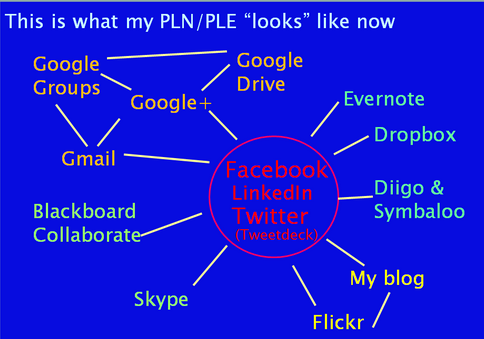
I have got rather used to being on holiday – for those of you anywhere other than Australia, schools and TAFE here have their long summer break over Xmas and the New Year. This means (in my particular college) that unless you have a good reason for being on campus you have to take leave from just before Xmas to the end of January. However being “on holiday” doesn’t mean doing nothing work related. I am currently (and rather intermittently) trying to get my head around Flash – more of that in a later post, learning more about PLNs, slowly extending my Twitter network (tweeting regularly). Sue Waters and myself also re-started our Free Online PD sessions for the year and the next one is on Friday 23rd Jan, 09:00 Western Australian time through Elluminate. The link is: https://sas.elluminate.com/site/external/launch/meeting.jnlp?sid=675&password=M.200F5C3B0FE18DAB974B678B2EF277

If you are thinking of joining us and are not familiar with Elluminate you will find it useful to go to their support site and this will step you through configuring your system

Online PD on Friday 16th Jan 2009

At last Friday’s Online PD session we heard about the Poweful Learning Practice model for professional development from Robin Ellis and Chris Harbeck. There was a lively discussion about the merits (and otherwise) and some implications of using Facebook with students – particularly school age ones. We finished off with a discussion about using time limited challenges as a learning facilitation tool.

Ideas on time framed challenges - whiteboard from Free Online PD 16/01/09

From Free Online PD Friday 16th Jan 09

Now for something completely different – the other part of my life!

As well as all these unofficial work related activities we have lots of things happening on the block. This time of year tends to be a peak time for lots of fruit and veg to be ready all at once, since well before Xmas we have been eating zucchini, summer squash, bush beans, carrots, runner beans, strawberries and raspberries. We fought a continuing battle with small brown birds (SBBs) (weebills and silvereyes) – they get through the most amazingly small holes in the bird netting – to eat some of our cherries before they did. We still have zucchini and carrots and the next row of beans are starting to flower. We have also been harvesting sweetcorn

(some of these will be frozen) and are picking tomatoes, cucumbers and okra as well as lettuce and radish. Plums are being picked.

Peaches and grapes ripening, melons and pumpkins growing larger every day. All of this largesse means much processing – drying, making jam and some freezing. The ultimate aim is some veg fresh from the garden available all year round and surplus preserved one way or another for use when there is not much fresh.

As well as all the garden stuff (including sewing up holes in bird netting) we are preparing our outdoor area (courtyard and under verandahs) for paving. It will be sooooo good not to have the outdoor area and pool in a building site after over 6 years of sand and gravel underfoot between house and pool, wobbly chairs and unlevel table and barbecue for sitting out – I can’t wait!! However this means 2-3 hours each morning – when it is cooler than our current 38-40 deg C daytime maxima – leveling and moving sand.

We have to level it all (250 square metres) down to this!

Luckily there was plenty of excess on the house pad, and we just need to take it down to the bottom of the brickwork – we are having poured limestone and hope this will be lower maintenance than pavers.

The end!

At last I have finished – this is a very messy piece of writing that lacks both a real theme and much coherence – but at least it got me past the non-writing stage!